


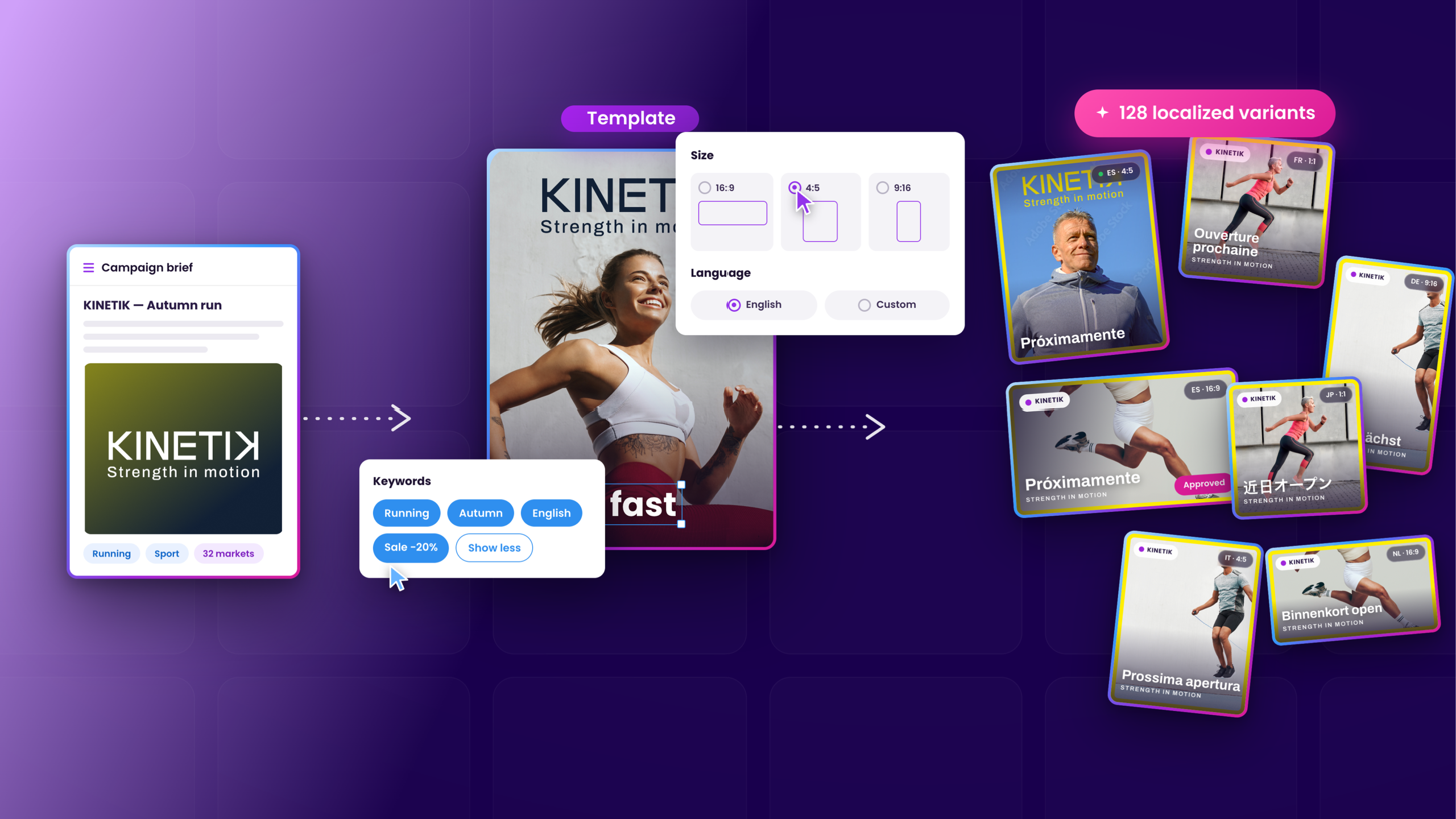
One of the recurrent mantras we have here at Storyteq is “We want to help creative teams be creative again”. But how do our Creative Automation tools fulfil these ambitions?
It’s a fundamental question that every brand who runs ads at scale needs to ask themselves. The challenge in this centers on the current demanding ad landscape we’re in. This ‘attention recession’ requires greater ad personalization: companies need a way to effectively create and deliver ads that resonate while keeping their creative production capability lean.
But this is easier said than done. While more teams invest time and money in advanced marketing tools to automate campaign development and delivery, they end up blasting ads with a single message. This model is wrong because it’s missing the context of consumers’ behavior and the multiple channel requirements for different ad formats, sizes, and markets.
Consumers want personalized experiences. They are sending clear signals about where they are in their lifecycle, their preferences, and their intent, so companies should tap into these data sources to produce personalized videos and other content that matches their audience’s intent. And with the right tools and mindset, this is actually achievable.
But one major challenge that keeps you from reaching your audience this way is the actual ad production process. This can be made more effective. Let’s dive right in!
Why do designers need Creative Automation?
Creative Automation is the process of leveraging technology to scale certain aspects of your banner or video ad such as size, format, CTAs, graphic elements to enable high-volume ad creation for high-volume demand. So, in a nutshell, Creative Automation helps creatives and marketers to scale ads automatically and save time.
As advertisers, you create personalized experiences that bridge the gap between your product and your consumers’ interests, behaviors, and expectations. From a production perspective, this means thinking through your ad’s format, language, and messaging from the ideation stage. But most likely your creative team will end up grappling with producing multiple ad variants. While this sounds achievable, it starts becoming an issue when you want to follow the same workflow for 20 different countries or audience groups.
The beauty of Creative Automation is that it takes all of the components of that ad and creates all the variations you need instantly. Variations for all of your markets (language adaptations), audience groups (stance, copy adaptation) or your products (product inventory and product sheet adaptation).
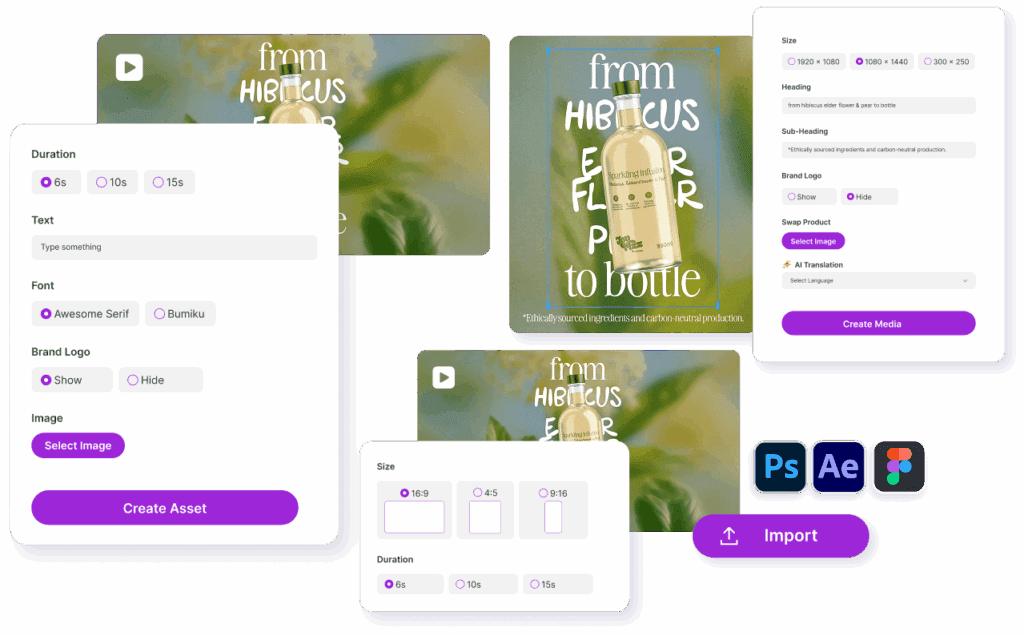
We believe creativity takes time, but creative production shouldn’t. Creative teams are meant to focus on designing, editing and animating their craft, rather than being consumed by avoidable repetitive tasks.
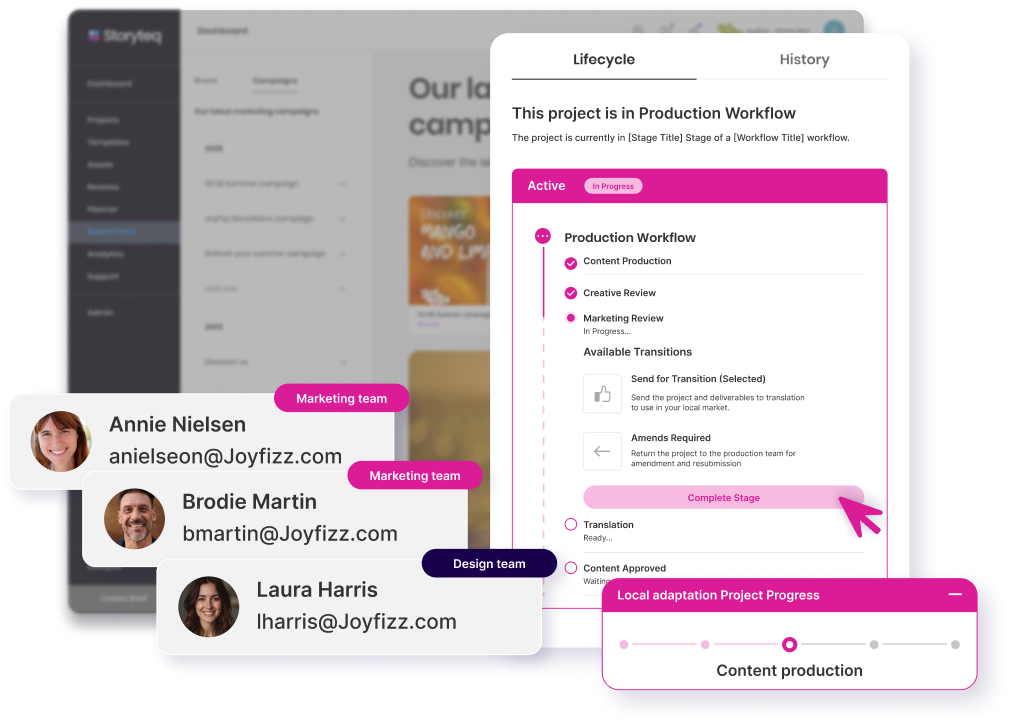
This type of issue left unchallenged can quickly increase your need for resources and higher budget, derail goals, and burn out your employees who are frantically trying to reach impossible deadlines. A single weak process like this can create a ripple effect that impacts the performance of the whole company. If you understand how Creative Automation can be a great time asset to nurture your creative processes, then you’re thinking from a business perspective of measurable and quantifiable results. Working from one platform also ensures less back and forth between departments and consequently, a much faster output which is all brand compliant.
Freeing up time for creativity also offers a myriad of extra benefits: it enables teams to focus more on high value activities and consider market trends. It is those who embrace Creative Automation who will gain an innovative edge and stay ahead. The pressure is on, but as the need for creative assets increases, your processes should evolve along with them. Differentiate your brand from the competition and achieve pixel perfection with Creative Automation.
Why should every digital creative lead know about Creative Automation?
> The current demanding ad landscape we’re in requires greater ad personalization, but this in turn demands more time and money in the production process of versioning ads to suit different audience members.
> The beauty of Creative Automation is that it takes all of the components of that ad and creates all the variations you need instantly.
> We believe creativity takes time, but creative production shouldn’t. Creative teams are meant to focus on designing, editing and animating their craft, rather than being consumed by avoidable repetitive tasks.
What drives the need for Creative Automation tools?
New ad channels and formats
As channels have evolved and multiplied, they also started to introduce more formats. Social channels like YouTube, TikTok, or Instagram now handle videos, which offers flexibility to use them across many stages of the marketing funnel.
This has a cascading effect on marketers, who now need to consider what the right way to communicate with their audience is. Is it through banners? Or videos? And should these be generic or should they be personalized?
Consumers increasingly expect to see this video content from brands. But on the production side, this is always more challenging.
Personalization for consumers
Ad personalization is another driver not only because it’s a great opportunity for you to turn audiences into customers but it’s about leveraging your knowledge of your audience to create highly relevant experiences for them.
The downside? It falls back on more demand for creative teams to come up with the right assets.
Advanced ad strategies
If you look at all the algorithms that ad channels are applying, you’ll see they’re cross-testing ads in real time against certain segments.
Algorithms are getting more precise and advanced so if you want to be on par with them, you need to make sure you’re not just testing one piece of content across multiple segments. Instead, you’re testing multiple pieces of content across multiple segments.
For instance, Facebook’s Pitch, Play, Plunge concept pushes you to differentiate your content and derive your creatives in different formats based on the stage where your audience is, whether they are scrolling or are more engaged.
Ad fatigue
With Creative Automation, you can repurpose, recycle, or reshuffle the elements in a creative. This way, you can turn an old creative into a new high quality one (for example, by swapping scenes in the case of a video) to combat ad fatigue.
The inefficiency of adding headcount
This isn’t a new problem. In his book, “The Mythical Man-Month”, software engineer Fred Brooks famously observed, adding more people to a struggling team usually adds communication overhead, not output — the same logic applies to a creative team drowning in manual asset production.
In digital advertising, you can apply the same law. There’s also a limit to what a designer can do with one keyboard and one brain and 24 hours. Even for the best in the world, accelerated progress comes from increasing the amount you can get done per unit time.
The creative is king: Engage your audience with creative visual ads
Design matters. In any visual ad campaign, the creative concept does most of the heavy lifting for performance. Not the media buy.
By having extra time to conceptualize your creatives, you will give them a longer shelf life, allowing your design team to stay consistent on the design process.
Designers know that storytelling is imperative. When stories resonate with your audience, it becomes far easier to motivate them to act. Dynamic messaging in your ads allow you to target audiences at any stage of the customer journey.
The secret to crafting a good story is to give in to the audience’s natural desire to problem solve, deduce, and deduct. Don’t give the audience the whole story all at once.
With this in mind, how can you leverage the power of dynamic creatives to create ads that tell stories like so? Sequential storytelling enables your audience to see a series of stories in a given order, enabling them to follow them as if they were going through a journey. As a creative, this provides new opportunities to put your imagination to work to rethink ad stories that work together, not just alone as singular creatives.
However, doing this manually is not an option because creating all this versioning takes too much time.
Key takeaways
- Consumers want personalized experiences; they are the ones sending clear signals about where they are in their lifecycle, their preferences, and their intent, so companies should tap into these data points to produce ads that match their audience’s intent.
- Creative Automation could save you a massive amount of time for creatives you were already making, but also enable you to produce and try out more versions at a fraction of added costs.
- Creative Automation enables teams to focus more on high value activities and consider market trends. It is those who embrace Creative Automation who will gain an innovative edge and stay ahead.