You use AI for campaign adaptation across channels by automatically resizing, reformatting, and personalizing creative assets to meet the specifications and audience expectations of each platform. Instead of manually rebuilding every ad or piece of content for each channel, AI reads your master creative and generates channel-ready variants at scale. The sections below break down exactly how this works, which channels benefit most, and how to build a workflow around it.
What does AI actually do when adapting campaigns across channels?
AI campaign adaptation works by analyzing a source creative, extracting its core components (copy, imagery, layout, messaging hierarchy), and then rebuilding those components to fit the technical and contextual requirements of each target channel. The result is a set of channel-specific variants that retain the campaign’s intent without requiring manual production for each format.
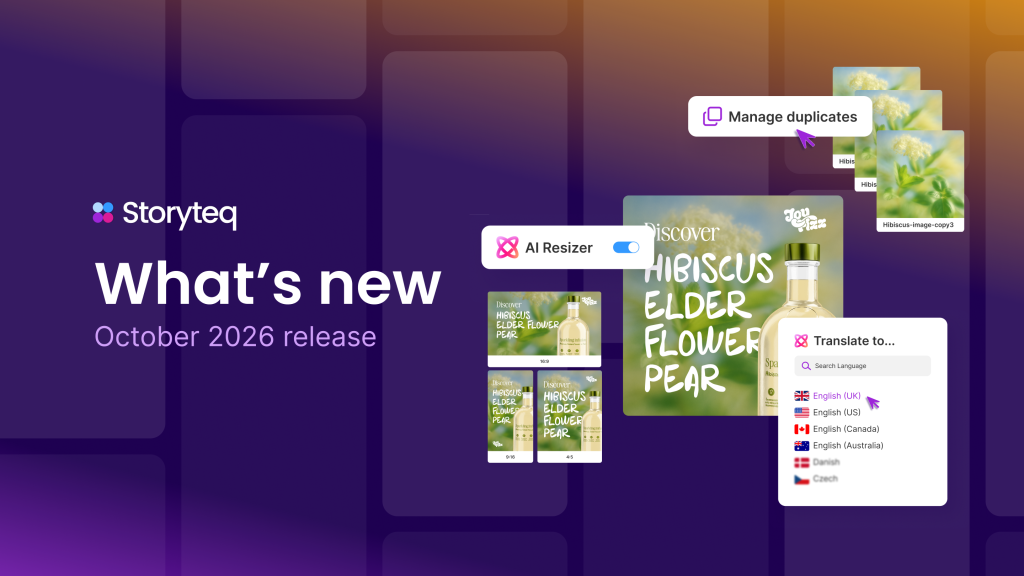
In practice, this involves several distinct functions running in parallel. AI reads the dimensions, aspect ratios, and file specifications required by each platform. It then repositions design elements, adjusts text length, and scales visual assets to fit without breaking the composition. For personalization, AI pulls from audience data or predefined rules to swap in relevant copy, imagery, or calls-to-action for different segments.
What makes this genuinely useful is the speed. A campaign that might take a production team several days to adapt manually can be rendered across dozens of formats in minutes. This gives marketing teams the bandwidth to run more campaigns, test more variants, and respond to market changes faster.
Which channels benefit most from AI-driven campaign adaptation?
Paid social, display advertising, and video are the channels that benefit most from AI-driven campaign adaptation. These formats require the highest volume of size and format variants, making manual production time-consuming and expensive. AI handles format multiplication across these channels faster and more consistently than any manual process.
- Paid social: Platforms like Meta, TikTok, LinkedIn, and Pinterest each have unique aspect ratios, character limits, and creative best practices. AI generates compliant variants for each without starting from scratch.
- Display advertising: Standard IAB display formats span dozens of sizes. AI adapts a single master banner into the full suite automatically.
- Video: Horizontal, square, and vertical video formats serve different placements. AI reframes footage, adjusts timing, and applies platform-specific overlays.
- Email: AI personalizes subject lines, hero images, and body copy blocks based on audience segments or behavioral data.
- Out-of-home and digital signage: AI scales static or animated assets to large-format specifications while preserving visual quality.
Channels with fewer format variations, such as print or podcasts, see less direct benefit from AI adaptation. But for any channel where volume and personalization intersect, AI delivers measurable efficiency gains.
How does AI maintain brand consistency across adapted content?
AI maintains brand consistency across adapted content by working from a locked set of brand parameters: approved fonts, color palettes, logo placements, tone-of-voice guidelines, and approved asset libraries. Every variant the AI generates pulls from these parameters, so no matter how many formats or channels are involved, the output stays on-brand.
The mechanism behind this is template-based production. Rather than generating creative freely, AI operates within structured templates that enforce brand rules at the component level. A headline can only use approved typefaces. Background colors must fall within the defined palette. Logo size and placement follow fixed rules. This constraint-based approach is what separates AI-assisted brand adaptation from unconstrained generative AI, which can drift from brand standards.
Approval workflows add another layer of control. Before adapted content goes live, human reviewers can check outputs against brand guidelines and flag anything that falls outside acceptable parameters. This combination of AI-enforced constraints and human review keeps brand integrity intact even at high production volumes.
What’s the difference between AI adaptation and dynamic creative optimization?
AI adaptation and dynamic creative optimization (DCO) are related but distinct. AI adaptation focuses on producing channel-ready creative variants from a master asset, reformatting and personalizing content for different platforms. DCO focuses on assembling and serving the best-performing combination of creative components in real time, based on live performance data and audience signals.
AI adaptation: production-side automation
AI adaptation happens before a campaign goes live. It takes a finished or near-finished creative and generates the full range of format variants needed for multichannel distribution. The output is a library of ready-to-deploy assets. This is primarily a production efficiency tool.
Dynamic creative optimization: delivery-side intelligence
DCO operates at the point of ad serving. It assembles ads dynamically from a pool of approved components (headlines, images, CTAs) and selects the combination most likely to perform well for a given user, context, or moment. DCO requires live data feeds and ad server integration to function.
Many multichannel campaign automation setups use both: AI adaptation to build the asset library efficiently, and DCO to serve the right variant to the right audience at the right time. They solve different problems in the same campaign workflow.
How do you set up an AI-powered campaign adaptation workflow?
Setting up an AI-powered campaign adaptation workflow starts with defining your master creative and the channel set you need to cover, then building templates that encode your brand rules, and finally connecting your asset output to your distribution channels. The workflow has five core stages.
- Define your channel matrix: List every channel and format you need to produce. Include dimensions, file types, character limits, and any platform-specific creative requirements.
- Build a master creative: Produce one high-quality source asset that contains all the core campaign elements. This becomes the input for AI adaptation.
- Create locked brand templates: Build templates for each channel format that enforce your brand parameters. These templates control how AI adapts the master creative without breaking brand rules.
- Set personalization rules: Define which content elements should vary by audience segment, geography, language, or behavioral trigger. Connect these rules to your data sources.
- Connect to distribution: Integrate your AI adaptation platform with your ad delivery systems, DAM, or campaign management tools so adapted assets flow directly into active campaigns.
The most common failure point in this setup is poor template design. If templates are too rigid, they limit what AI can do. If they are too loose, brand consistency breaks down. Investing time in template architecture before scaling production pays off significantly in output quality.
What are the biggest limitations of AI in campaign adaptation?
The biggest limitations of AI in campaign adaptation are creative judgment, contextual nuance, and data dependency. AI excels at format multiplication and rule-based personalization, but it cannot replace the strategic and cultural judgment that experienced creatives bring to campaign decisions.
- Creative judgment: AI follows rules but does not evaluate whether an adapted creative is genuinely compelling. A technically compliant variant can still be visually weak or tonally off.
- Cultural and contextual nuance: Adapting campaigns for different markets involves more than translation. Humor, imagery, and messaging conventions vary significantly by culture, and AI often misses these subtleties without human input.
- Data quality dependency: Personalization at scale only works if the underlying audience data is accurate and well-structured. Poor data leads to poorly targeted variants, regardless of how good the AI is.
- Template limitations: AI works within the constraints you set. If your templates do not account for every edge case, the output can break in unexpected ways at scale.
- Approval bottlenecks: High-volume AI output can overwhelm review processes if approval workflows are not designed to handle scale. The speed of AI production only delivers value if the review process keeps pace.
Understanding these limitations helps you design a workflow that uses AI where it genuinely adds value and keeps human judgment in the loop where it matters most.
How Storyteq helps with AI campaign adaptation
We built our platform specifically to solve the production and consistency challenges that come with multichannel campaign adaptation. Our Creative Automation Platform gives marketing and creative teams the tools to go from a single master creative to a full library of channel-ready assets, without sacrificing brand control or creative quality.
- Ad Engine: Automates the generation of on-brand ad variants across every channel and format, directly from your master creative and locked brand templates.
- Brand Portals: Centralize approved assets and brand guidelines so every adapted variant draws from the same trusted source.
- Reviews and Approvals: Streamline the feedback and sign-off process so high-volume AI output does not create a bottleneck at the review stage.
- Ad Delivery Integration: Connect adapted assets directly to your distribution platforms, cutting the time between production and a live campaign.
- Content Automation: Apply personalization rules at scale, swapping in audience-specific copy, imagery, and calls-to-action across every variant.
If you want to see how this works in practice for your campaigns, book a demo with us and we will walk you through the platform with your specific use case in mind.