You combine AI with template-based marketing production by using AI to generate, adapt, and personalise content within pre-approved template structures. The templates define the boundaries — brand rules, layout, approved assets — while AI handles the variable work: writing copy variations, resizing visuals, and populating dynamic fields at scale. Together, they give marketing teams speed without sacrificing brand control.
This approach works for any team producing high volumes of campaign assets across multiple channels, markets, or audience segments. The sections below break down how each part of this combination works in practice.
What does AI actually do inside a template-based production workflow?
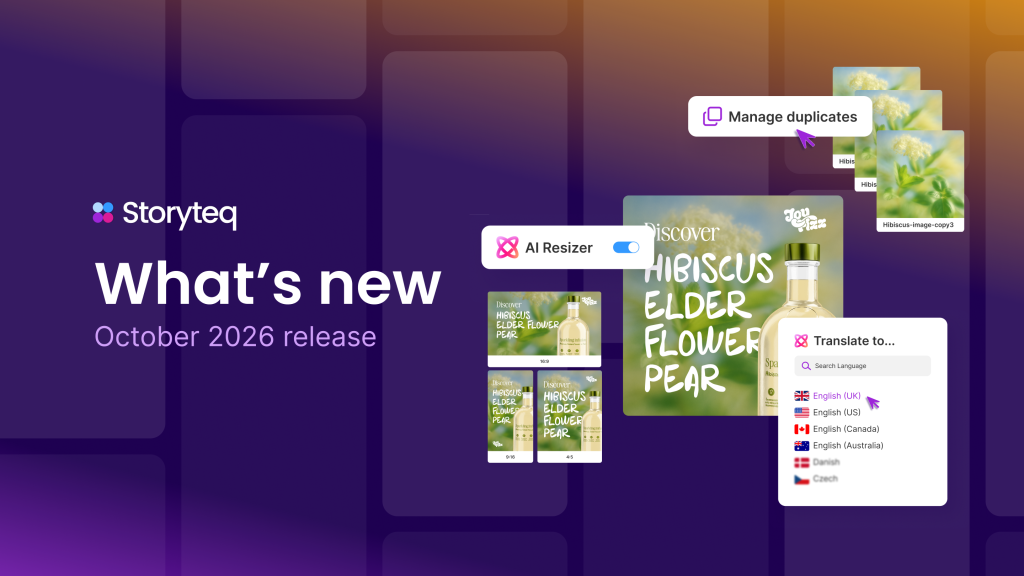
Inside a template-based production workflow, AI automates the variable elements of each asset. It generates copy variations, selects or adapts visual components, translates content across languages, and populates dynamic fields based on audience data or campaign parameters. The template provides the fixed structure; AI fills it intelligently and at speed.
In practical terms, this means a single master template can produce hundreds of asset variants without a designer manually adjusting each one. AI reads the input data — product name, target market, promotional offer, language — and outputs a completed asset that fits within the template’s defined layout and brand rules.
This is where AI marketing production becomes genuinely useful. Instead of replacing creative judgment, AI handles the repetitive execution work that slows teams down. Creative professionals define the rules once, and AI applies them consistently across every output.
How does template-based production keep AI output on-brand?
Template-based production keeps AI output on-brand by encoding brand rules directly into the template structure. Fonts, colour palettes, logo placement, image safe zones, and approved copy formats are all locked into the template before AI touches any content. AI can only work within those constraints, which means every output automatically meets brand standards.
This is the structural advantage of combining AI with templates rather than using AI alone. A standalone AI tool can produce content quickly, but it has no inherent understanding of your brand guidelines. Templates give AI the guardrails it needs to produce output that is both fast and compliant.
For global marketing teams managing multiple markets, this matters significantly. Local teams can use AI to adapt content for their region without being able to break the visual or tonal rules set by the central brand team. The template acts as a brand governance layer that scales with the AI’s output volume.
What types of marketing assets benefit most from AI and templates combined?
The marketing assets that benefit most from combining AI with templates are those produced in high volumes, across multiple variants, or requiring frequent localisation. These include digital display ads, social media creatives, email campaign banners, video ads, and promotional landing page content.
Assets with predictable structures and variable content are the strongest candidates for AI template-based marketing. Consider the following:
- Digital display ads: Same layout, different offers, audiences, or markets — AI populates each variant from a single template
- Social media creatives: Platform-specific sizing and format rules are locked into templates; AI adapts copy and imagery per audience segment
- Video ads: AI can swap voiceovers, text overlays, and product shots within a templated video structure
- Email banners and headers: Personalised per recipient segment without manual design work for each version
- Retail and promotional materials: Price, product, and offer fields update automatically across large product catalogues
Assets that rely heavily on bespoke creative concepts or one-off campaign ideas are less suited to this model. Template-based AI production delivers the most value where volume, consistency, and speed are the primary production challenges.
How does AI-powered template production differ from manual creative workflows?
AI-powered template production replaces the manual, repetitive steps of a traditional creative workflow with automated processes. In a manual workflow, a designer creates each asset individually, applies brand guidelines by hand, and iterates through rounds of feedback. In an AI-powered template workflow, the design decisions happen once at the template level, and AI handles all subsequent production at scale.
The difference shows up most clearly in time and output volume. A manual workflow might produce ten ad variants in a day. An AI-powered template workflow can produce hundreds of variants in the same timeframe, with consistent quality across all of them.
Manual workflows also create bottlenecks at every handoff point — briefing, design, review, revision, approval. Template-based AI production compresses or removes several of these stages. Reviews happen at the template level rather than asset by asset, and approvals can be applied systematically rather than individually.
This does not mean creative teams become redundant. It means their time shifts toward higher-value work: defining the creative strategy, building the templates, setting the rules, and evaluating campaign performance rather than executing repetitive production tasks.
What tools and integrations are needed to combine AI with template production?
To combine AI with template-based production effectively, you need a creative automation platform that connects template management, AI content generation, and distribution into a single workflow. The core components include a template builder, an AI engine for content generation, a digital asset management system, and integrations with your ad delivery and campaign management platforms.
Here is what a functional technology stack for automated creative production typically includes:
- Template management: A tool that lets designers build and lock brand-compliant templates with editable dynamic fields
- AI content generation: An engine that generates copy, adapts visuals, or translates content based on campaign inputs
- Digital asset management (DAM): A library of approved brand assets that AI can draw from when populating templates
- Review and approval workflows: Integrated feedback tools so stakeholders can approve outputs without leaving the platform
- Ad delivery integrations: Direct connections to paid media platforms so approved assets are published without manual export steps
- Analytics: Performance data that feeds back into the production process to inform which template variants perform best
The integrations matter as much as the individual tools. A disconnected stack creates manual handoffs between systems, which reintroduces the delays that AI and templates are designed to eliminate.
How do you measure the impact of AI-driven template-based production?
You measure the impact of AI-driven template-based production by tracking metrics across three areas: production efficiency, content performance, and brand consistency. Efficiency metrics include time-to-publish, number of assets produced per campaign, and reduction in revision cycles. Performance metrics include engagement rates, conversion rates, and cost per asset. Brand consistency can be measured through compliance audits and a reduction in off-brand asset incidents.
Production efficiency is often the first measurable gain. Teams moving from manual workflows to AI content automation typically see a significant reduction in the time between brief and published asset. Tracking this before and after implementation gives you a clear baseline comparison.
Content performance metrics help you understand whether speed is translating into results. Producing more assets faster only adds value if those assets perform. A/B testing different AI-generated variants within the same template structure gives you data on which copy, visuals, or offers drive better outcomes.
Brand consistency is harder to quantify but no less important. Tracking the number of brand guideline violations flagged in review, or the proportion of assets that pass first-time approval, gives you a measurable indicator of whether the template guardrails are working as intended.
How Storyteq helps with AI template-based marketing production
We built our platform specifically to connect AI-powered content generation with template-based production workflows, giving marketing and creative teams the tools to produce at scale without losing brand control. Here is what we offer:
- Creative Automation Platform: Build master templates once, then use our Ad Engine to generate unlimited on-brand asset variants automatically across formats and markets
- Reviews and Approvals: Streamline feedback and sign-off directly within the platform, reducing revision cycles and keeping production moving
- Ad Delivery Integration: Publish approved assets directly to your media platforms without manual export steps
- Digital Asset Management: Store and surface approved brand assets so AI always draws from the right source material
- Analytics: Track which template variants perform best and use that data to inform your next production cycle
If you want to see how this works in practice for your team, request a demo and we will walk you through the platform.