You keep brand consistency while scaling creative production by building structured systems around your creative process rather than relying on individual judgment. That means combining standardized templates, clear brand guidelines, and automated workflows so every asset produced across every channel reflects the same visual and verbal identity. The sections below unpack the most common questions teams face when trying to maintain on-brand content as production volume grows.
What makes brand consistency break down at scale?
Brand consistency breaks down at scale when creative production outpaces the systems designed to govern it. As teams grow, campaigns multiply, and channels diversify, the informal knowledge that kept early creative work on-brand stops being enough. Without documented guidelines and enforced processes, individual interpretation fills the gap and introduces variation.
The most common triggers for brand drift during high-volume marketing creative production include:
- Decentralized teams working from different asset libraries, each using slightly different logo versions, color codes, or font files
- Unclear ownership of brand guidelines, meaning no single person or team is accountable for enforcing them
- Manual handoffs between designers, copywriters, and regional teams that introduce errors at every stage
- Speed pressure that leads teams to skip review steps and ship assets before they have been properly checked
- Fragmented tooling where assets live across email, shared drives, and local folders, making it easy to use outdated files
The result is not always dramatic. Brand consistency problems at scale tend to accumulate gradually: a slightly off-color button here, a wrong typeface in a regional adaptation there. Over time, those small deviations add up to a fragmented brand experience that erodes audience trust.
What are the biggest risks of inconsistent branding across campaigns?
Inconsistent branding across campaigns damages audience recognition, weakens trust, and reduces the overall return on your marketing investment. When your brand looks or sounds different depending on the channel or region, audiences cannot build a reliable mental image of who you are, which makes every campaign work harder to achieve the same impact.
Beyond perception, inconsistent branding creates measurable operational risks:
- Rework costs: Assets that do not meet brand standards need to be corrected and reproduced, consuming time and budget that could go toward new creative work
- Legal and compliance exposure: Regulated industries face real risk when brand assets include incorrect disclaimers, outdated logos, or unauthorized imagery
- Channel fragmentation: Audiences who see your brand differently on social, display, and video are less likely to connect those touchpoints into a coherent brand relationship
- Internal confusion: When teams disagree about which version of an asset is correct, it slows production and creates conflict between creative, marketing, and legal stakeholders
Maintaining on-brand content at scale is not just a creative concern. It directly affects how efficiently your marketing operation runs and how effectively your campaigns convert.
How does creative automation help maintain brand consistency?
Creative automation helps maintain brand consistency by removing the manual steps where human error and individual interpretation typically introduce variation. Instead of asking designers to recreate assets from scratch for each campaign or channel, automation generates new creative from pre-approved, locked templates that enforce your brand guidelines by design.
When you automate creative production, brand rules are embedded into the system itself. Color palettes, typography, logo placement, safe zones, and approved copy structures are defined once and applied automatically across every output. A designer adapting a campaign for ten markets does not need to manually check each asset against the brand guide because the template does that work.
Automation also enables personalization at scale without sacrificing consistency. You can produce hundreds of asset variations, each tailored to a specific audience segment, channel format, or regional market, while every version stays within the same brand framework. That combination of volume and control is difficult to achieve through manual production alone.
What role do brand templates play in high-volume creative production?
Brand templates are the structural foundation of high-volume creative production. They define the approved layout, visual hierarchy, and design parameters for each asset type, so anyone producing content works within a pre-set framework rather than making design decisions from scratch. Templates reduce production time, minimize errors, and make brand compliance the default rather than something teams have to actively remember.
Effective templates for scaling creative production share a few important characteristics:
- Locked brand elements: Logos, color values, and font specifications are fixed and cannot be altered by end users, preventing accidental deviation
- Editable content zones: Headlines, body copy, imagery, and localized text can be updated within defined parameters, giving teams flexibility without creative freedom that undermines brand guidelines
- Format variants built in: A single master template generates multiple format sizes automatically, so teams are not manually resizing assets for each channel
- Version control: Templates are maintained centrally, so when brand guidelines update, the change propagates across all future production without requiring teams to track down old files
Templates shift the creative team’s role from repetitive production work to higher-value decisions about strategy, messaging, and creative direction. That shift is what makes genuine content at scale possible without proportionally scaling headcount.
How do approval workflows reduce brand errors in creative teams?
Approval workflows reduce brand errors by creating structured checkpoints where assets are reviewed against brand guidelines before they are published or distributed. Without a defined workflow, review happens informally or not at all, and brand errors only surface after assets have already reached audiences or been sent to media partners.
A well-designed approval workflow assigns clear responsibility at each stage. Designers submit assets, brand managers review for compliance, legal or compliance teams check regulated content, and regional leads confirm local accuracy. Each reviewer works within their area of expertise, and no asset moves forward until the relevant sign-off is recorded.
Beyond catching errors, structured approvals create an audit trail. When a brand inconsistency is identified after the fact, you can trace exactly which stage it passed through and where the process needs strengthening. That feedback loop is what allows creative teams to improve their brand compliance over time rather than repeating the same mistakes across campaigns.
Digital approval tools accelerate this process significantly compared to email-based review. Reviewers can annotate directly on the asset, compare versions side by side, and approve or reject with a single action. That reduces the back-and-forth that typically makes manual review a bottleneck in high-volume marketing creative production.
Which teams should own brand consistency when scaling production?
Brand consistency at scale requires shared ownership across multiple teams, with clear accountability assigned at each level. No single team can maintain brand standards alone when production volume is high and creative work spans multiple channels, markets, and formats.
A practical ownership model typically distributes responsibility as follows:
- Brand or creative strategy team: Owns the brand guidelines themselves, including visual identity, tone of voice, and approved usage rules. This team defines what on-brand means and updates guidelines as the brand evolves.
- Creative production team: Responsible for building and maintaining the master templates that encode brand guidelines into the production system. They translate brand rules into practical tools that other teams can use.
- Marketing operations team: Owns the workflow infrastructure, including approval processes, asset management systems, and the tooling that connects creative production to campaign delivery.
- Regional or channel teams: Responsible for applying templates correctly within their markets and flagging situations where local requirements create tension with global brand guidelines.
The most important structural decision is appointing someone, whether a brand manager, creative director, or marketing ops lead, with explicit authority to enforce brand standards and resolve disputes when teams disagree. Without that accountability, brand consistency becomes everyone’s responsibility in theory and no one’s in practice.
How Storyteq helps you maintain brand consistency at scale
We built our platform specifically to solve the tension between creative volume and brand control. When you use Storyteq, brand consistency is not something your team has to manually police. It is built into the production system itself.
Here is what that looks like in practice:
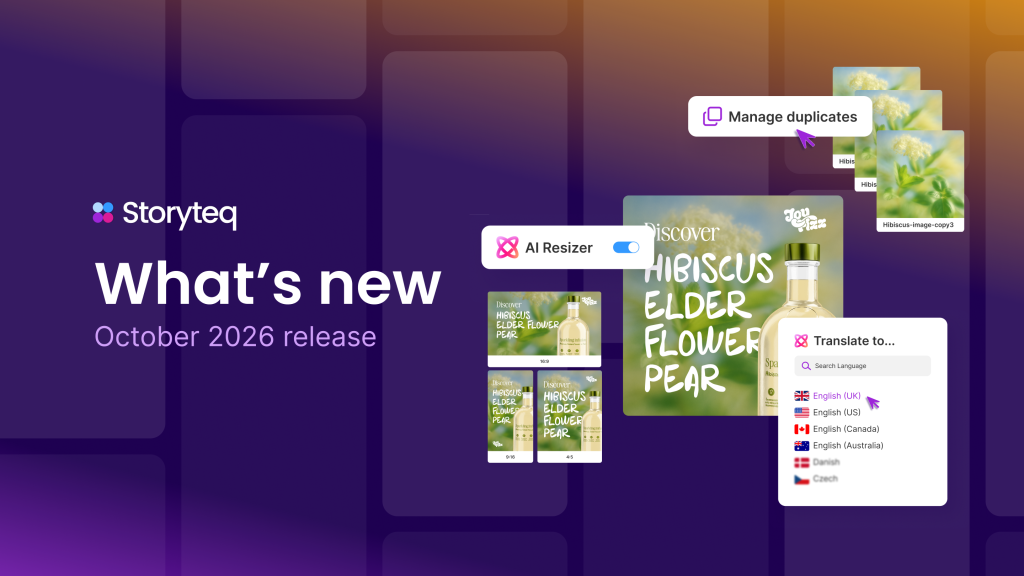
- Locked brand templates that encode your visual identity, so every asset produced across every market stays within your approved guidelines without requiring individual review
- Creative automation that generates format variants, localizations, and campaign adaptations from a single master, eliminating the manual resizing and rebuilding that introduces errors
- Review and approval workflows built directly into the platform, so stakeholders can annotate, approve, and track assets without leaving the system or relying on email chains
- Digital Asset Management that gives every team access to the correct, current version of every asset, removing the risk of outdated files being used in live campaigns
- Brand portals that give regional and partner teams self-serve access to approved creative within defined parameters, extending brand reach without extending brand risk
If your team is producing content at scale and finding that brand consistency is slipping, we can show you how our platform addresses that directly. Request a demo and see how creative automation works in practice.