

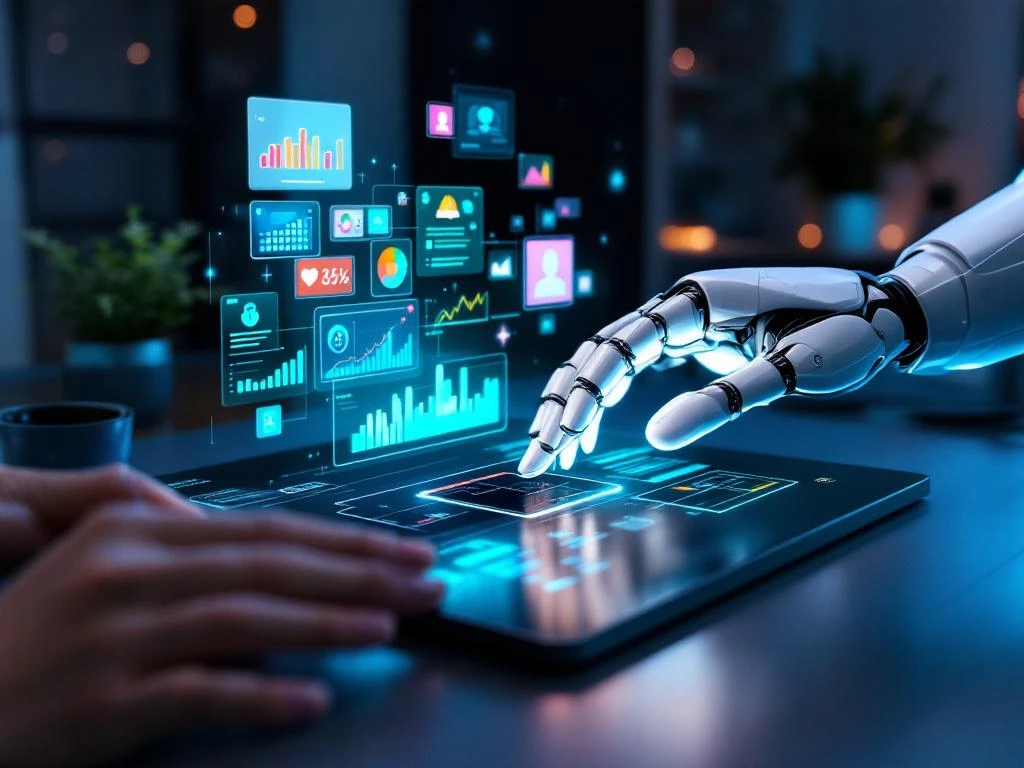
AI generation software creates a diverse range of content types across multiple formats. Modern AI tools can produce text content like blog posts, social media captions, product descriptions, and marketing copy. They can generate visual assets including images, graphics, banners, and social media visuals. Video content, personalised ads, email templates, and interactive media can all be created through AI-powered automation. These tools help marketers produce content at scale whilst maintaining brand consistency, freeing creative teams to focus on strategy and high-value work rather than repetitive tasks.
What types of content can AI generation software create?
AI generation software can create a wide spectrum of content formats essential for modern marketing. Text-based content includes blog articles, social media posts, email newsletters, product descriptions, and ad copy. Visual content ranges from marketing graphics and social media visuals to display advertisements and banner ads. For multimedia, AI can generate personalised video content, animated graphics, and interactive elements.
Beyond creation, AI tools excel at content adaptation—transforming existing assets into multiple variations by modifying elements like text, images, colours, and layouts. This capability allows brands to quickly produce localised versions of campaigns, adapting messaging for different markets, languages, and platforms.
AI-powered content generation has revolutionised how marketing teams approach content production by:
- Automating repetitive content adaptation tasks
- Scaling production without sacrificing quality
- Maintaining brand consistency across channels
- Enabling data-driven personalisation
- Streamlining approval workflows
By leveraging dynamic templates with AI capabilities, marketers can instantly generate thousands of variations from a single master asset, making content creation more efficient and responsive to market demands.
How do AI systems generate marketing visuals?
AI systems generate marketing visuals by analysing brand guidelines and using algorithms to create on-brand graphics. These systems operate through dynamic templates—base assets with elements designated as modifiable. When generating marketing visuals, AI processes brand assets like logos, fonts, and colour schemes, then applies them consistently across various designs whilst allowing for customisation.
The process typically involves these key steps:
- Creating a master template that defines the visual structure
- Identifying which elements can be dynamically changed (text, images, colours)
- Setting parameters that maintain brand consistency
- Inputting variables through data sources or manual selection
- Automating the generation of multiple variations
For example, a single banner ad template can be transformed into hundreds of variations with different headlines, backgrounds, and calls-to-action, each maintaining the brand’s visual identity. This eliminates the need for designers to manually create each version, reducing production time from days to seconds.
Post-production AI has proven particularly valuable in visual content creation. Rather than generating content from scratch, these tools excel at tasks like auto-resizing, background removal, and image swaps, automating the more technical aspects of visual adaptation while preserving creative intent.
Can AI software create personalized video content?
Yes, AI software can create personalized video content at scale by adapting key elements based on audience segments or individual preferences. Modern AI-powered platforms can modify various components of a video including text overlays, voiceovers, visual elements, music, and even entire scenes to create tailored experiences for different viewers.
The personalization process typically works through:
- Dynamic video templates that define which elements can be customized
- Data integration that pulls audience information from CRMs or other sources
- Rules-based systems that determine which content variations to display based on user attributes
- Automated rendering that produces unique video versions without manual editing
For instance, a single video campaign can be automatically adapted with different languages, product images, pricing, and offers based on the viewer’s location, browsing history, or customer segment. This level of personalization was previously impractical due to the enormous production resources required.
By using AI-driven video personalization, brands can deliver more relevant content that resonates with specific audiences, potentially increasing engagement and conversion rates. This approach transforms video from a one-size-fits-all medium to a highly targeted communication channel that can be deployed at scale across markets and segments.
You can learn more about personalized video automation and how it integrates with broader marketing strategies.
How does AI enhance content workflow management?
AI enhances content workflow management by automating approval processes, organizing assets intelligently, and streamlining collaboration between team members. At its core, AI-powered workflow systems create centralized platforms where all aspects of content production—from creation to review to distribution—can be managed cohesively.
Key workflow enhancements include:
- Automated task assignment and tracking that ensures projects move efficiently through production stages
- Intelligent asset organization that makes finding and reusing content simple
- Streamlined feedback and approval processes that reduce revision cycles
- Version control systems that maintain clear records of changes and approvals
- Automated distribution that delivers content to the right channels at optimal times
These AI capabilities eliminate many manual coordination tasks that traditionally consume marketing teams’ time. For example, instead of emailing files back and forth for feedback, AI platforms can automatically route content to appropriate stakeholders, collect and organize their comments, and track approval status—all within a single system.
By removing these workflow bottlenecks, creative teams can focus more on strategic and creative work rather than administrative tasks. This shift not only improves efficiency but also enhances job satisfaction by allowing team members to concentrate on higher-value activities.
What are the limitations of AI-generated content?
AI-generated content, despite its advantages, faces several important limitations. The most significant boundary is in original creative conceptualization—AI excels at adapting and varying existing ideas but struggles with truly innovative thinking and emotional nuance that human creatives naturally provide. AI systems work from patterns in existing content rather than genuine creative inspiration.
Other notable limitations include:
- Limited understanding of subtle cultural contexts and sensitivities
- Difficulty generating content that requires emotional intelligence or empathy
- Potential for reproducing biases present in training data
- Challenges with highly specialized or technical industry knowledge
- Inability to make strategic judgments about brand positioning
This is why hybrid approaches are proving most effective. In these workflows, humans provide creative direction, strategic guidance, and quality control while AI handles execution, adaptation, and scale. The human element remains essential for setting the creative vision, ensuring brand alignment, and making judgment calls about what will resonate with audiences.
For instance, humans might develop the core creative concept and messaging for a campaign, while AI automates the adaptation of that concept across different formats, sizes, and platforms. This partnership leverages the respective strengths of both human creativity and AI efficiency.
How can brands measure the impact of AI-generated content?
Brands can measure the impact of AI-generated content through a combination of performance metrics, engagement analytics, and conversion tracking across marketing channels. Effective measurement begins with establishing clear baseline metrics before implementing AI content tools, allowing for meaningful before-and-after comparisons.
Key performance indicators to track include:
- Content production efficiency (time and resources saved)
- Content quality and consistency across channels
- Audience engagement metrics (views, clicks, time spent)
- Conversion rates from AI-generated content
- A/B testing results comparing different AI-generated variations
- ROI calculations factoring in reduced production costs
AI itself can enhance the measurement process through automated performance tracking and analysis. Modern platforms can automatically aggregate data across channels, identify which content variations perform best, and provide actionable insights for optimization.
This data-driven approach enables continuous improvement, allowing brands to refine their AI content strategies based on real-world performance. For example, if certain visual elements consistently drive higher engagement, these insights can inform future content creation.
By systematically measuring both operational improvements (efficiency, cost savings) and marketing outcomes (engagement, conversions), brands can quantify the full business impact of their AI content investments.
At Storyteq, we’ve seen how proper implementation of AI-driven content automation can transform marketing operations, helping brands create more personalized, effective content at scale while freeing creative teams to focus on strategy and innovation. If you’re interested in exploring how AI can enhance your content production, request a demo of our platform to see these capabilities in action.